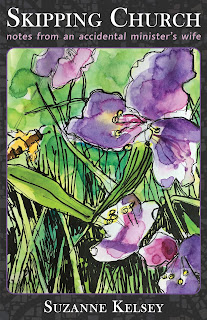
The Buddha taught that attachment to anyone or anything or any place is futile because nothing ever stays the same. Change is the only constant. All is impermanent.
—Suzanne Kelsey, Skipping Church: Notes from an Accidental Minister's Wife
The Buddha taught that attachment to anyone or anything or any place is futile because nothing ever stays the same. Change is the only constant. All is impermanent.
—Suzanne Kelsey, Skipping Church: Notes from an Accidental Minister's Wife
Hadrian’s Wall is fake in that sense, a reconstruction of the Roman wall that is a tourist destination rather than a border; there is England on both sides of the wall wherever it crops up. I was participating in a ritual of sorts, a faux ritual, perhaps, walking the wall from Wallsend to Bowness-on-Solway. . . Ritual is part of the many social constructions of religion, just as Clayton’s Wall is part of the many constructions of Hadrian’s Wall, since all of it has been rebuilt at one point, either by emperors after Hadrian or by archaeologists. None of these different functions, for the wall or for religion, are bad. They just are. As a scholar of religion, I try to peel back the layers of meaning to see the different ways religion is formed and how it functions over time and within a society. In many ways I work as an archaeologist works on the wall, looking for layers, dating objects and repairs, describing the function in different times and places, trying to decide what was and what might have been, peeling back the appearances and the practices for the origins. Since I work on living religions, in particular Christianity, this often bothers people. Religion as a rule has not wanted this story told or its origins revealed. . . Religion wants the past as a beautiful image, not a messy reality.
—Bob Royalty, Walking Hadrian’s Wall
But is there a silver lining for the world in this Covid pandemic? Or, to put it differently, in the language of logotherapy, what is the meaning of this time?
At any moment in time, all sorts of futures are possible—an uncountably infinite number of possible futures. Which future happens is only partly outside our control. To a great extent, it’s up to us.
And just as in research, when certain ideas are so ripe that multiple groups can simultaneously invent a novel approach (often leading to battles over patents and Nobel Prizes), the meaning of certain points in history is not only what ends up happening, but what could have happened. It’s the choice, the branch-point, the fork in the road, and the decision made. It’s not just the inn you find by accident after many hours on the road and the person you meet there who becomes the mother or the father of your children, and the stories you tell for years later about how lucky you were that you didn’t turn left instead of right; or the person next to you at the bar who puts something in your drink when your back is turned so that you wake up hours later in a room, alone, with your wallet and your dignity gone, and the stories you will tell then. When all of that is in the future, the meaning of a moment is in all the possible paths forward. Some lead to justice and a healthier planet, but some do not.
The meaning of this moment in time, of these Corona times, is in what path we choose to take. That is the meaning of this time . . .
Wisdom and the will to change: this would be the greatest silver lining.
—Kimmen Sjölander, “The Art of Isolation: Amsterdam in Corona Times,” Still Point Arts Quarterly, Summer 2021
It is not the way of leaves
to care about how they fall.
It doesn’t matter
whether there are heavy, thunder-filled
clouds overhead
or miles of bright blue and sunshine.
A leaf doesn’t
cry out in pain if a harsh wind
tugs it from its twig
nor does it giggle with mischief if it
manages to break free on its own.
A leaf doesn’t
fret over which is better —
to swoop down in a wild, swirling canopy,
a rustling riot of yellow magic with hundreds of others,
or to flutter demurely to the ground
in a quiet, private moment.
No leaf even considers holding on,
resisting its destiny,
its part in the inevitable pattern.
For the leaf, simply letting go
is the thing.
—Stacey Murphy, Old Stones Understand
—Mary Dian Molton, About Franz: Remembering C. G. Jung—A Son's Story
—Jeri Ann Griffith, “In the Waters,” Still Point Arts Quarterly, Spring 2021: My Deep Love of Place
The first time I saw New Mexico, before I owned a cell phone or computer, I wrote a story about a woman who walked through the desert as the wind peeled the flesh from her bones. Her bones turned to dust and blew away. I meant it as a story of transmutation, dust returning to dust. That story foretold my own, how once in my lifetime a place grabbed hold of my soul. But it was never my land to own. I could only borrow it for an infinitesimal speck of time.
—Suzanne Finney, “Red Dust Suspended,” Still Point Arts Quarterly, Num. 41, Spring 2021
Now, in our own global pandemic, I consider how easily our familiar institutions can be disrupted and our sense of continuity shaken to the core. Yet everything on the Outer Cape is in a state of perpetual and reassuring impermanence; nothing ever stays quite the same. All you can do is be vividly awake to the living continuum.
—William Bless, “Outer Shores,” Still Point Arts Quarterly, Num. 41, Spring 2021
image credit: m01229, Cape Cod National Seashore, 2014. Wikimedia Commons
—Julie Tallard Johnson, The Clue of the Red Thread: Discovering Fearlessness and Compassion in Uncertain Times
Some fifteen years later, not long after we’d moved onto our land, I turned the dirt on the south-facing side of our house into a vegetable garden with raised beds I built myself. I filled them with carefully measured proportions of topsoil, sand, compost, blood meal, and bone meal, concocting a balanced environment of calcium, phosphorous, nitrogen, and potassium. I turned the mixture over and over, placing the spade into the dirt and stepping on the ledge of it, until the loam and the bone and stench were one.
When the soil was ready, I planted: basil and oregano and sage in peat pots that I started inside under ultraviolet light; sugar snap peas and red leaf lettuce early from seed; zucchini and spaghetti squash a little later; red peppers, Japanese eggplant, and finally, Roma tomato seedlings when I was certain there was no chance of frost.
For a few years, we had fresh salads, well-seasoned chicken and fish, and an August of zesty stews made with peppers, tomatoes, and eggplant. But the growing season in our microclimate was too unpredictable, too short. There were too many rows of green tomatoes hanging in the garage each fall. The rich soil and the cool climate, I decided, were better suited to roses like those my mother planted wherever we lived.
Despite my own passion to reproduce the gardens of my youth, I discouraged my husband from propagating our farm with the hardwoods that reminded him of his origins—oak, maple, and hickory—trees that grow slowly, live forever, and drop richly colored leaves in the fall. I’m fond of them, too, but I didn’t want to be like the early settlers of the West who brought cuttings of their favorite Eastern plants with them, trying to make the strange open spaces of the West look familiar. I didn’t want a farmhouse that pretended it was in Ohio. When my husband showed me a small hickory tree, I placed my hands on my hips before passing judgment. “Put it behind the barn where I can’t see it,” I told him, as though it was a rusted old bicycle. He ignored me.
One day I looked out the kitchen window, across the lawn and partway into the pasture, and saw him watering the tree. We squabbled over its location for a few days until he finally looked me in the eye, and with his chin set, said, “I want to be buried on this farm, beneath a tree like the ones we had in our yard when I was growing up.” He looked away before continuing. “And I want it to be in a place where you’ll see me when you look out the window.”
My husband was in good health, but as we moved into the second half of our lives, I understood not only his thinking about his own mortality, but the desire to have a sense of continuity--to bring his past to his present and imagine it his future. When we got married, my husband left the house he had lived in since he was one year old. He’d helped plant the hickory and maple in the front yard and measured his own growth with theirs. My family moved frequently. I learned to adapt to new environments. I did not become attached to a particular house, but to the gardens my parents created wherever we settled. When my husband planted hardwood trees and I planted tomatoes and roses, we were reproducing not just vegetation, but our histories. We were thinking of heritage and legacy, of unbroken chains, in broader ways than people do when they have biological children, because we had to.
—Lois Ruskai Melina, The Grammar of Untold Stories
Outside our artificial constructs—house, vehicle, shops, and schools—the real cosmos teems. We pass it or ignore it day after day, and then life ends without us ever having shimmered in the moonlight or cajoled along a rocky ridge bereft of civilization, without our letting the cry of the coyote raise goosebumps on our evening-chilled flesh.